
What a window well is for
Plenty of basement windows sit partly or all the way below the ground outside. The window well is the open pit in front of that window. On a lot of houses its wall is galvanized steel, bent in a curve and fastened to the foundation. Some wells are plastic. Older Des Moines houses sometimes have wells built of brick, block or stone.
The well holds the dirt back from the glass and lets some light and air in. It also catches whatever falls or runs into it: rain, snow, leaves, grass clippings. All of that has to leave through the bottom, or it sits against the window.
Why wells give out in Des Moines
A metal well sits in wet dirt all year. The bottom edge rusts first, then the seams. Once it rusts through, dirt and water push in at the bottom and the well starts to fill with mud.
The ground here is heavy clay left behind by the glaciers. It swells when it is wet, shrinks in a dry spell and heaves when it freezes. Year after year that pushes on the well. Some wells get bent in. Others pull away from the house, and then water runs down the gap between the well and the foundation, straight to the window.
Low ground near the Des Moines and Raccoon rivers takes on more water, and a well there has more to drain.
Then there is winter. Snow drifts into open wells, and more gets shoveled in off the walk. In spring it melts while the ground under it is still frozen, so the water cannot soak down. It sits in the well, right against the window.
Wells that sit too low
A well is supposed to stick up a little above the ground around it, so rain running across the yard goes around it. Over the years that changes. New mulch every spring, a load of black dirt for the flower bed, fresh sod. Bit by bit the yard comes up until the top of the well is even with the ground or below it.
After that, every hard summer storm sends water off the lawn and into the well. If a downspout empties nearby, the well gets that water too. Raising the well or setting a new one at the right height is often the fix, along with sloping the dirt back away from the house.
Signs a window well needs work
Any one of these is worth a photo to Joe. Take one from the yard looking down into the well and one from inside the basement at the window.
- Water on the sill or the floor under a basement window after rain or snowmelt
- Rust holes or rotted metal along the bottom of the well
- A well that is bent in, tipped over or pulled away from the house
- Water that stands in the well long after the rain stops
- The top of the well even with the yard, or lower
- Rotted wood or peeling paint around the inside of the basement window
What replacing a well involves
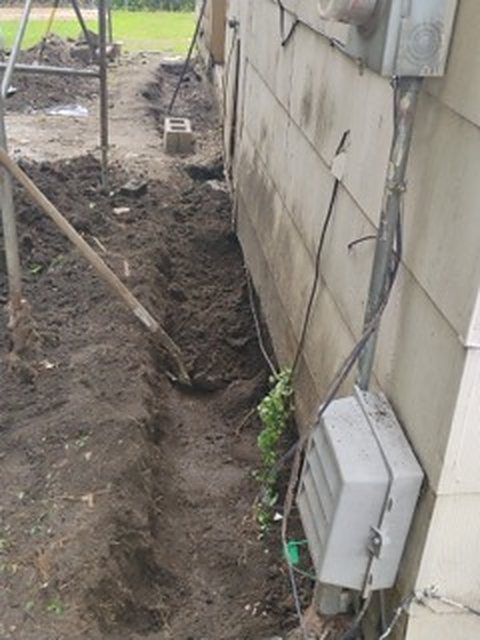
The old well comes out, and that means digging out the dirt around it. With the well gone, the wall behind it is open to see. That part of the foundation has often been wet for a long time, and on an old stone or brick wall the mortar there can be soft.
The new well gets set at the right height, fastened to the foundation and sealed where it meets the wall. The bottom gets gravel, not dirt, so water can soak down and away. Some houses have a drain pipe down along the footing that a well can be tied into, and some do not. Ask Joe what makes sense for yours.
Then the dirt goes back in around the well and gets sloped away from the house, so rain runs off away from the window.
Covers, cleanup and egress wells
A clear cover keeps snow and leaves out and still lets light through. Ask Joe about one when he looks at the well. If the window is an egress window, any cover has to open from below without tools so a person can get out, and the City of Des Moines can tell you what it allows.
Some of the upkeep is yours. Pull the leaves out every fall. Keep snow out of the wells, and do not shovel the walk into them. Point downspouts away. Keep mulch and dirt below the top edge. If a well keeps filling after all that, the trouble is in the well or the ground around it.
A new basement bedroom needs a bigger well, sometimes with a ladder or steps in it. That is part of putting in an egress window, which JC Cement also does.