If your question is not here
Text Joe a photo. A wide shot of the wall or the wet spot and a close one of the worst part tell him more than a description can. Say what part of town you are in and how long it has been going on.

These answers cover common questions about Des Moines basements: why they take water, what happens to old stone and brick walls, what coating a wall in cement does, tuckpointing, egress windows and window wells. For anything about your own house, call or text Joe Gomez at JC Cement, (515) 777-5018, with a photo.
Text Joe a photo. A wide shot of the wall or the wet spot and a close one of the worst part tell him more than a description can. Say what part of town you are in and how long it has been going on.
Not sure what it needs? Send Joe a photo.
Basement work and the masonry that goes with it: basement waterproofing, repair of old stone and brick basement walls, tuckpointing, egress windows and window wells. Waterproofing is the main one.
The ground in Des Moines is mostly heavy clay, and it holds water right against the basement walls. When a lot of rain falls fast, gutters overflow, downspouts dump at the wall and the ground gets soaked. That water finds old mortar, cracks, the joint where the wall meets the floor and window wells.
Snow piled against the house melts while the ground under it is still frozen, so the water cannot soak down. It runs along the top of the frozen ground toward the walls. Then spring rain lands on top of it. Moving snow away from the house and running downspouts out away from the walls both help.
Many older Des Moines houses sit on walls of rough stone or soft old brick laid in lime mortar. That mortar is soft to start with, and after many years of damp ground and frost it turns to sand and falls out. Loose stones follow. A lot of those walls can be filled, tuckpointed and coated in cement. A wall that is bowing in or still moving may need a structural engineer to look first.
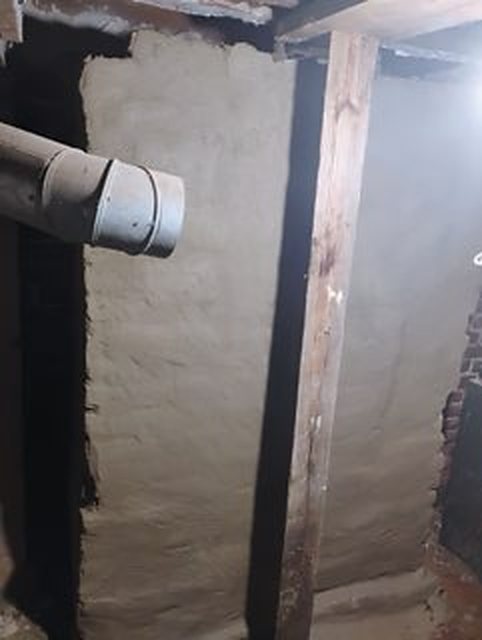
It is also called parging. It holds a crumbling wall surface together, fills the low spots and gives you a smooth wall that is easier to keep clean. It slows damp coming through. On its own it will not stop water pushing in hard from outside, and it will not fix a wall that is moving. The loose stuff has to come off and the joints get filled first.
On some old walls Joe pours a new concrete ledge along the bottom. Steel forms go up along the wall with rebar inside them, and concrete gets poured into the forms. The bottom of an old wall is often the most worn part, since that is where water sits, and the ledge covers it with new concrete. Joe will tell you if your wall needs one.
Tuckpointing means cutting out mortar that has gone soft or sandy and packing new mortar into the joints. A wall needs it when you can scrape the mortar out with a key, see gaps between the bricks or stones, or find sand on the ground or the floor under the wall. Iowa winters freeze and thaw the water in those joints over and over, and that is what breaks them down.
A basement bedroom needs a way out other than the stairs, and an egress window is that way out. The City of Des Moines sets the rules for the size, how high the sill can be and the well outside, and it decides if a permit is needed. Ask the city, then talk with Joe about where the window can go.
Clean out the leaves and dirt first and check where your downspouts empty. If the top of the well is down at the level of the yard, or the metal has rusted through, the well needs to be raised or replaced. Joe puts in new window wells and replaces old ones.
It is called efflorescence. Water moving through the wall carries salts with it, and when the water dries at the surface the salts stay behind as a white powder or crust. The powder tells you water is coming through the wall. Brush it off dry. Paint put over it does not stay, because the water keeps pushing more salts out behind the paint.
Thin cracks that never change are common, especially in poured walls. Mark the ends of the crack with a pencil, write the date next to it and take a photo, then check it again every few months. A crack that grows, lets in water, runs sideways along a block wall or comes with the wall bowing in needs a closer look, and some of those need a structural engineer first.
Clean the gutters and make sure the downspouts empty well away from the house, not at the wall. Look at how the ground slopes along the house; it should fall away from the walls. Keep snow shoveled back from the foundation in winter and clear out the window wells. And take a photo each time water shows up, so you know where it starts.
Call or text Joe at (515) 777-5018. Send a wide photo, a close photo of the worst part, your part of town and how long it has been going on. Joe looks at it and tells you what he would do.
Des Moines, Iowa, in Polk County. If your house is in another town nearby, call or text and ask Joe.
Don't see your question? Call Joe at (515) 777-5018
Joe tells you where the water is coming from and what the wall needs before anything gets dug or cut.
Joe Gomez, owner
A photo of the wall or the wet spot helps him answer. Call or text (515) 777-5018.