
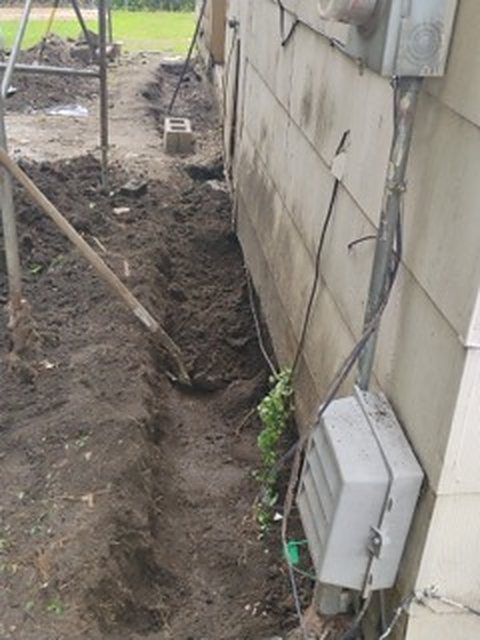
Clay ground that holds water against the wall
Des Moines sits on heavy clay soil left behind by the glaciers. Clay drains slowly. When it gets wet it stays wet, and it holds that water right up against the outside of your basement walls for days after the rain stops.
Clay also moves. It swells when it soaks up water and shrinks in a dry spell, and in a hot, dry stretch of summer you can see it pull away from the foundation and leave a gap along the house. The next storm runs straight down that gap to the wall. In winter the frost heaves the same ground. All that moving, year after year, works on the weak spots in a wall.
A basement wall can live with some damp. What it handles badly is wet ground pressed against it month after month. Water in the soil pushes on the wall, and it gets in anywhere it finds an opening.
The weather that brings it on
Des Moines winters freeze and thaw over and over, and snow piles up along the house. In spring that snow melts while the ground underneath is still frozen. The water cannot soak in, so it runs along the top of the frozen ground until it hits something, and a lot of the time that something is your foundation. Then the spring rains come on top of ground that is already full.
Summer is different. A thunderstorm can drop a lot of water in a short time. Gutters overflow, downspouts fall behind, and the ground right next to the house gets more water than it can take. A basement that stays dry through a slow, steady rain can still leak after one of those storms.
So pay attention to which kind of weather your leak follows. A leak that only shows up in March is telling you something different from one that shows up after every hard storm in July. The spring thaw guide on this site goes deeper into the snowmelt side of it.
Roof water dropped at the foundation
A roof collects a lot of rain, and the gutters and downspouts gather all of it into a few spots. If a downspout empties right at the base of the wall, every storm pours a roof's worth of water into the ground in that one place. The wet corner of a basement very often sits right under a downspout.
Gutters do the same thing when they clog. Leaves and seeds from the trees fill them up in the fall, and the next rain spills over the edge in a sheet. That water lands in a line along the house and soaks straight down beside the wall.
- Downspouts should carry water well out into the yard, not drop it at the wall
- Splash blocks should tip away from the house, and they shift over time
- Buried downspout lines can crush or plug with roots, and then the water backs up at the house
- Clean gutters in the fall and again in spring, and watch for spots that spill over in a hard rain
Ground that slopes the wrong way
When a house is built, the dirt dug out for the basement gets pushed back in around the walls. That fill dirt is loose, and it keeps settling for years. A yard that once sloped away from the house can end up flat, or sloping back toward it, with a low spot right along the foundation where water sits after every rain.
Other things tip the water the wrong way too. A patio or walk that has sunk and now leans toward the house. A flower bed with edging that holds water in like a pan. Mulch and dirt built up against the siding. The ground next to the house should fall away from it on every side, so rain runs out into the yard and not down along the wall.
Where the water gets through the wall
Once water is sitting against the outside, what the wall is made of decides how it gets in.
Older houses north and west of downtown, in places like Sherman Hill, Drake, Beaverdale and Highland Park, and in parts of the south side, have basement walls of rough stone or old brick laid in soft lime mortar. That mortar wears out over time and turns to sand. Water comes through the joints and leaves the wall damp across a wide area, and in a bad spot it runs.
Houses from the middle of the century mostly have concrete block walls. Block can crack along the mortar joints, and the hollow cores inside the blocks can fill with water and let it out low on the wall. When wet clay pushes hard enough, a block wall can start to bow in.
Newer houses have poured concrete walls. Those leak at cracks, at the spots where pipes and wires go through the wall, and at the joint where the bottom of the wall meets the floor. That joint is a seam between two separate pours of concrete, and water against the wall or under the floor finds it.
Window wells and low ground near the rivers
A window well is the pocket dug out in front of a basement window that sits below the ground. If it does not drain, it fills like a bucket in a hard rain and the water comes in around the window. There is a separate guide here on window wells that fill with water, with a list of things to check.
Then there is where your house sits. The Raccoon River runs into the Des Moines River downtown, and low ground near the rivers takes water. So does a house at the bottom of a hill, where water from the yards above all heads your way. In those spots water can come up from under the floor instead of in through the walls. That is a different problem from a leaky wall. Drain tile and sump pumps are the usual answer to it, and if you think that is what your house needs, ask Joe about it.
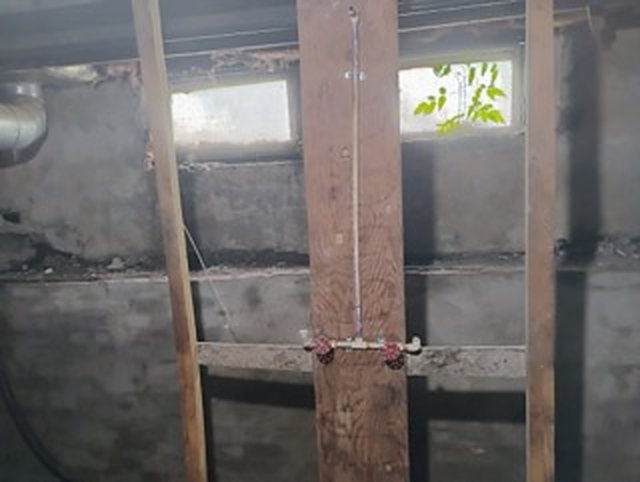
Reading the clues in your basement
Before anyone digs or cuts anything, figure out where the water shows up first. Go down during a hard rain or right after it with a flashlight and look along every wall and across the floor. Here is what the different spots usually mean.
- A wet streak high on one wall, under a downspout or a gutter that spills, points to roof water soaking in right there
- Water along the bottom of the wall on several sides points to wet ground pushing at the joint where the wall meets the floor
- Water coming up through the middle of the floor or a floor crack points to water under the house
- Water under a window points to the window well
- A wet line that follows a crack is coming through that crack
- Damp across the whole face of an old stone or brick wall points to tired mortar and wet clay outside
When it is only damp air
Not every wet basement is a leak. In a humid Iowa summer, warm damp air comes down into a cool basement, and the water in it condenses on the walls, the cold water pipes and the floor. It looks like a leak, and it can be heavy enough to leave puddles.
There is a simple test. Tape a square of plastic wrap or aluminum foil tight to the wall and leave it for a day or two. If water beads up on the room side, it is coming from the air, and a dehumidifier is the fix. If the side against the wall is wet, the water is coming through the wall.
Timing helps too. A leak that shows up within hours of a storm is usually surface water close to the house. One that shows up days later, or only in spring, is usually ground water working its way in slowly.
What you can do this weekend
A few of the causes above cost little or nothing to fix, and they are worth doing before anything else. Sometimes they are enough. If the water keeps coming, the notes and photos will save time when someone looks at it.
- Clean the gutters and make sure every downspout runs out into the yard
- Look at the ground along the house after a rain and fill low spots so water runs away
- Pull mulch and dirt back down off the siding and the top of the foundation
- Clear leaves and trash out of the window wells
- Write down the date, the weather and where the water showed up, and take photos
When to call JC Cement
When the yard and the gutters are squared away and water still gets in, the wall is the next place to look. JC Cement is Joe Gomez's business in Des Moines, and basement waterproofing is the main thing he does. He finds where the water is coming in, inside along the walls or outside against the foundation, and fixes it at that spot. Sometimes that means digging along the outside of the foundation to get at the wall from the side the water is on.
The basement waterproofing page explains how Joe goes about it. To get started, call or text Joe at (515) 777-5018 with a photo of the wet area, a close one of the worst spot, and what part of town you are in. If you live in a town near Des Moines, call or text and ask.