
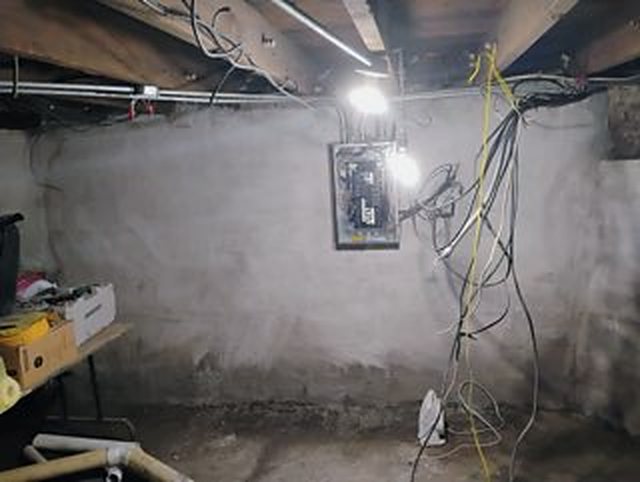
What is under an old Des Moines house
Many Des Moines houses built from the late 1800s into the 1940s sit on basement walls of rough stone, often limestone or fieldstone, stacked thick and laid up in mortar. Others have brick basement walls. Some have both, with stone at the bottom and brick on top where the wall comes up out of the ground.
The brick in those walls is usually softer than brick made today. The mortar is soft too. Most of it was lime mortar, made with lime and sand and little or no cement. It was meant to be the soft part of the wall. Lime mortar gives a little as the house moves and lets damp pass through and dry out, and when it wears, the joints wear before the stone or the brick does.
These walls have held their houses up a long time. But they were never built to keep water out the way a newer wall is. The basements are often low and damp, with small windows up at the top of the wall and old brick piers holding up the beam in the middle.
Why the joints turn to sand
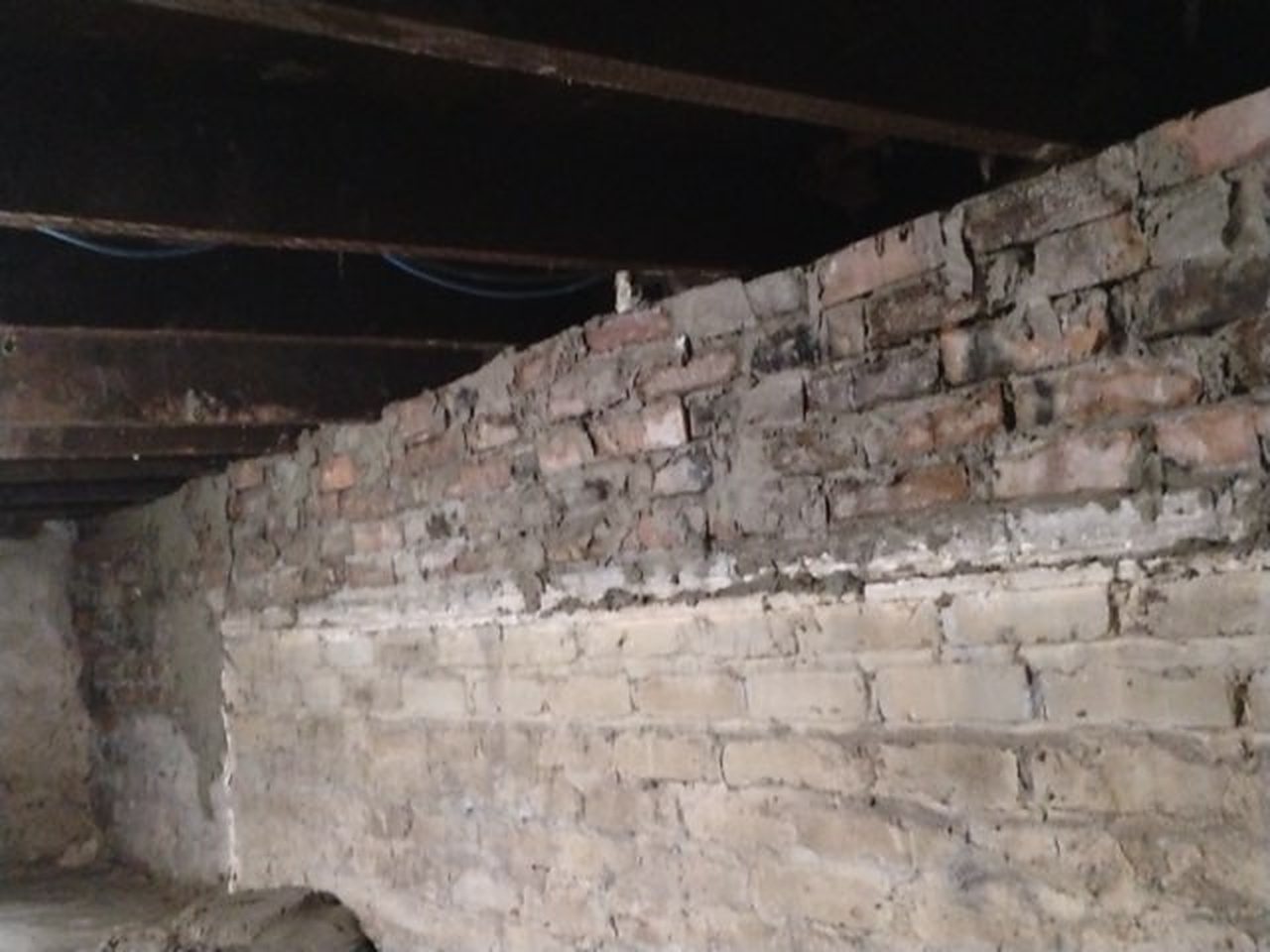
Lime mortar wears away a little every time water passes through it. The clay ground around Des Moines keeps the outside of these walls wet much of the year, so water is always working through. It carries the lime out with it bit by bit, and what is left behind is sand.
You can see it on the floor. A thin line of sand along the bottom of the wall that keeps coming back after you sweep it is mortar leaving the joints. Scrape a joint with a key or a screwdriver. Sound mortar is hard to scratch. Worn mortar crumbles and runs out like sugar.
Frost does its share on the part of the wall near the ground, where the mortar gets wet and freezes over and over through the winter. The guide on freeze, thaw and mortar goes into that.
Damp coming through the stone
Even a stone wall in decent shape passes some damp. Water in the ground outside wicks through the stone and the mortar and dries off the inside face. That is why these basements smell musty, why paint on the walls flakes off in sheets, and why a white crust shows up on the stone and the brick. That crust is salt left behind when water dries off the wall, and it means water is moving through.
The trouble starts when more water comes through than can dry off. Then the wall stays wet, the mortar goes faster, the bottom of the wall stays dark, and the basement never quite dries out between storms.
Signs a wall needs work
Walk the basement with a flashlight and a key. One or two of these in a corner is ordinary wear. When they show up along a whole wall, it is time to have someone look at it.
- Sand piling up along the base of the wall
- Joints you can dig out with a finger or a key
- Gaps and holes where the mortar is gone
- Stones that move when you push on them
- Brick faces crumbling or popping off, with red dust on the floor below
- A wall that stays dark and wet at the bottom
- Old patches cracking and falling away
How a hard patch can make it worse
The usual quick fix on an old wall is a bag of modern mortar mix smeared over the bad spots. It looks good for a while. But modern mortar with a lot of cement in it is much harder than lime mortar, and harder than old brick. It does not give with the wall, and it does not let damp through the same way.
When the joints are packed with something harder than the brick, the water in the wall has to leave through the brick instead. Then the faces of the brick are what crumble, and you lose brick instead of mortar. A hard patch over a wet stone wall can trap the damp behind it until the patch cracks and falls off. Paint, plastic sheeting and some sealers trap damp the same way.
So the material has to suit the wall. What goes into the joints of a soft old wall should be no harder than the stone or brick around it. Joe looks at what the wall is made of before he decides how to fix it, and when he tuckpoints, the new mortar is matched to the old.
What can be done
Most old stone and brick basement walls can be kept going. The work comes in some mix of the steps below, and which ones a wall needs depends on how far gone it is and how much water is reaching it.
- Tuckpointing, where the loose, sandy mortar is cut out of the joints and new mortar packed in
- Filling the holes and gaps where the mortar is long gone
- Coating the face of the wall in cement to hold the surface together
- A new concrete ledge poured along the bottom of the wall, where the base is the worst
- Dealing with the water, from gutters and grading to digging along the outside of the foundation
A coat of cement and a ledge at the base
A coat of cement over an old wall is a different thing from hard mortar packed into the joints. It goes on after the loose material is knocked off and the joints are filled, and it holds the face of a crumbling wall together. It also slows damp and keeps sand off the floor. It holds up when the water coming from outside has been dealt with too. Over a wall that is still soaked from outside, any coat can loosen in time.
The bottom of an old wall is often in the worst shape. That is where water sits longest and where the mortar goes first. Where a wall needs it, Joe sets steel forms and rebar along the base and pours a new concrete ledge, then coats the wall above it. The ledge covers the worn lower part of the wall in new concrete.
The parging guide on this site goes into coating a wall in cement, what it does and what it does not do.
The brick piers in the middle
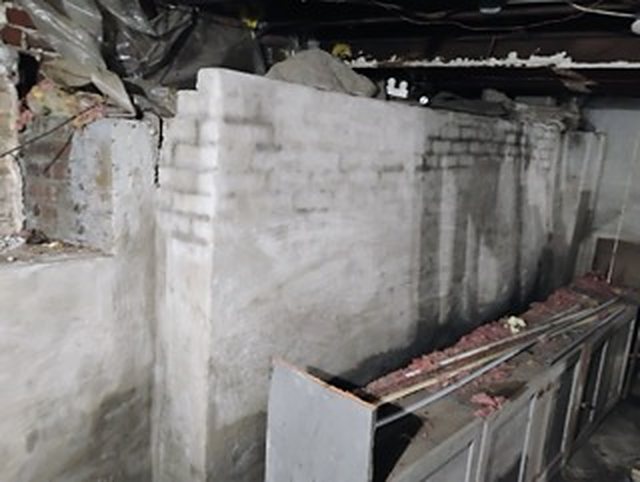
Many older basements have brick piers standing out in the floor, holding up the main beam. They are built the same way as the walls, with old brick and lime mortar, and they wear the same way. Damp wicks up into the bottom of them from the floor, and the mortar goes sandy at the base first.
A pier with sandy joints can be tuckpointed and wrapped in cement, which squares it up and holds the old brick together. A pier that is leaning, cracked through, or has a sagging beam on top of it is a bigger question, and it should be looked at before anyone patches it.
When a wall needs an engineer first
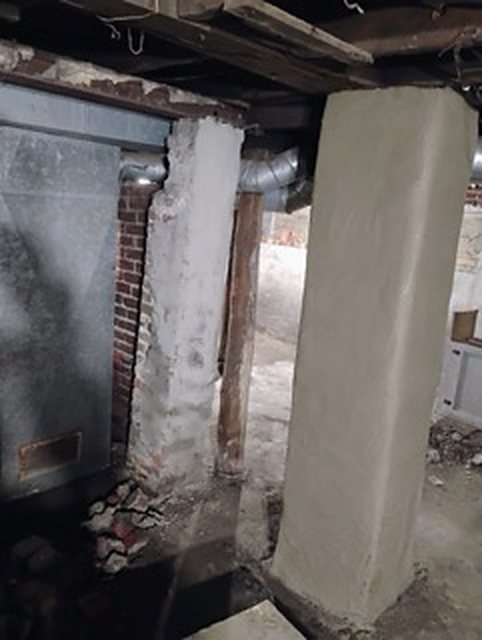
Some walls have moved, and tuckpointing or a coat of cement does not change that. Watch for a wall that bows in toward the room, leans, has a long crack running sideways across it, or has stones pushed out of line. Wet clay pressing on a wall for years can do that, and so can frost.
Some walls need a structural engineer to look first. An engineer can tell you if the wall is still moving and what it needs. If Joe looks at a wall and thinks it needs more than a coat, he will tell you that before any work starts.
Before you finish an old basement
A lot of people want to turn these basements into living space. It can work, but the walls come first. Framing and drywall set tight against a damp stone wall hide the wall from view and hold the damp in behind the drywall, and that ends in mold and a musty smell. Fix the water and the wall, let it dry out, and leave yourself a way to keep an eye on it.
If a bedroom is part of the plan, it needs an egress window, and that means a bigger opening in the foundation wall. The egress windows page covers that work.
Getting your wall looked at
JC Cement is Joe Gomez's business in Des Moines. Joe repairs old stone and brick basement walls: he fills and tuckpoints the joints, coats the walls in cement, pours a new ledge along the bottom where one is needed, and wraps old brick piers in cement. The basement wall repair page has more on how he does it.
Text Joe at (515) 777-5018 with a wide shot of the wall, a close one of the worst joints, and the part of town you live in.